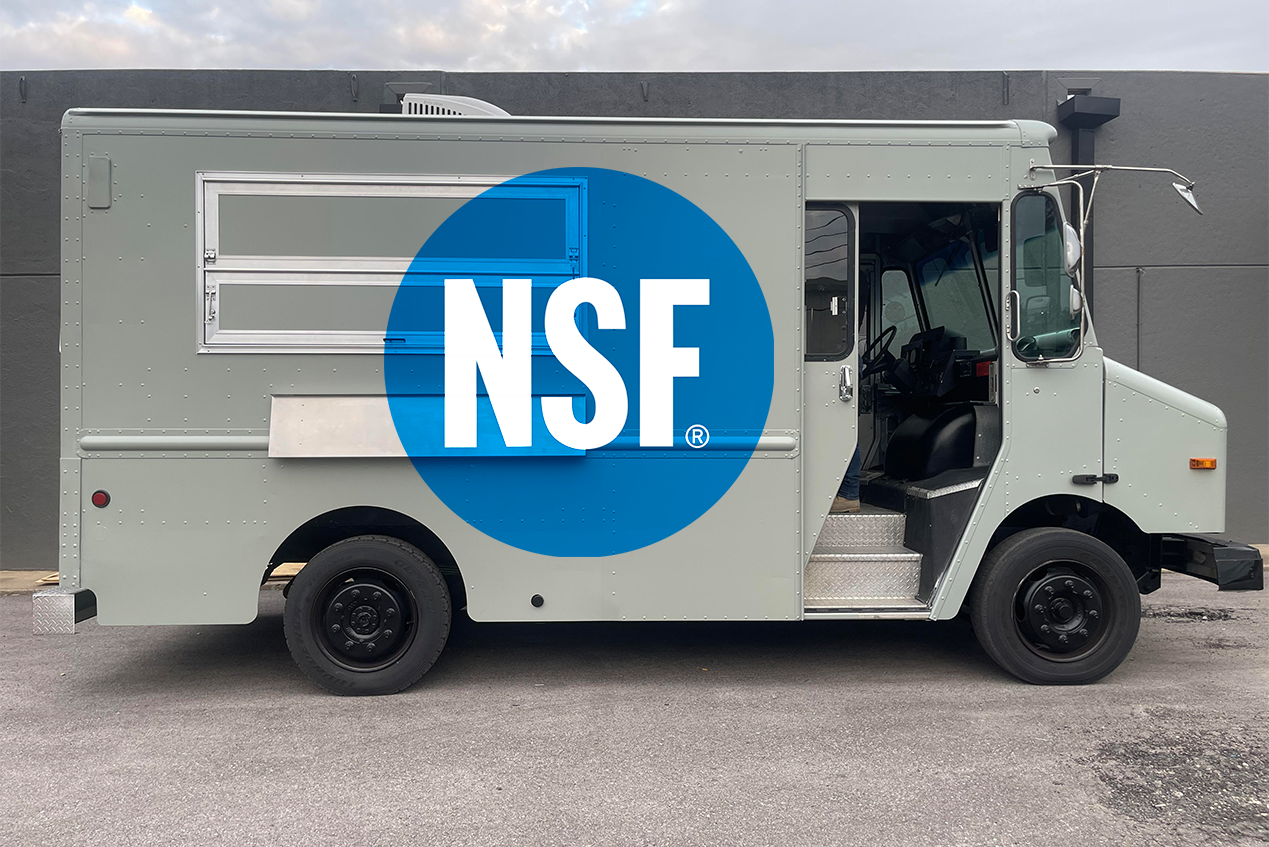
Food trucks operate in confined, high-output environments where equipment design directly affects compliance, sanitation, and long-term durability.
NSF certification determines whether the equipment inside a food truck meets recognized public health construction standards.
Key Takeaways
- NSF certification applies to specific food service equipment, not the entire vehicle.
- Many health departments expect NSF-listed components.
- Certified equipment reduces inspection friction and retrofit risk.
- Event organizers often require documented compliance.
- Integrating compliant materials during fabrication prevents costly redesign later.
What NSF Certification Means in Practical Terms
NSF certification verifies that a specific piece of equipment complies with sanitation and material safety standards established by NSF International.
Certification applies to sinks, prep tables, refrigeration units, holding cabinets, and other food-contact components that have been evaluated under ANSI-accredited standards. It is not a marketing label applied to an entire truck. It is product-specific validation.
When equipment is submitted for certification, engineers evaluate surface materials, weld quality, joint construction, corrosion resistance, and cleanability. They assess whether moisture can collect in seams, whether surfaces can withstand repeated chemical sanitation, and whether materials remain non-porous under heavy use. Manufacturing facilities are also audited to confirm consistency.
These structural decisions are closely tied to layout strategy. The way equipment is placed, spaced, and secured affects cleanability and inspection outcomes, which is why thoughtful planning during the food truck equipment layout process becomes part of compliance, not just workflow efficiency.
For operators, this translates into equipment designed for commercial sanitation conditions rather than light-duty fabrication.
Why NSF Certification Shapes Health Inspections
NSF-listed equipment gives inspectors immediate confirmation that sanitation construction standards are met.
Most local health departments rely on versions of the FDA Food Code. While rules differ by jurisdiction, inspectors commonly expect food-contact equipment to meet ANSI-accredited standards such as those administered by NSF.
During inspection, officials often look for certification markings on sinks, refrigeration systems, prep surfaces, and cooking equipment.
Certified products can be verified through the official listings maintained by NSF International.
When certification is present, inspection discussions focus on operational practices rather than material composition. When certification is absent, inspectors may require additional documentation or question construction methods, which can delay approval.
This is one reason early design decisions matter. The planning stage when designing your custom food truck directly influences whether inspection becomes routine or corrective.
Operators experience this difference in time and friction. Fewer clarifications. Fewer corrections tied to equipment build quality. Faster sign-off.
The Structural Risks of Non-Certified Equipment
Equipment that lacks recognized sanitation certification introduces long-term compliance exposure.
Mobile kitchens operate under vibration, humidity, grease accumulation, and temperature fluctuation. Under those conditions, minor construction flaws become sanitation liabilities. Uneven welds trap debris. Porous materials absorb moisture. Poor drainage design allows standing water.
Heat compounds these issues. High internal temperatures accelerate material breakdown and corrosion, which is why understanding how to stay cool inside your food truck is not just about comfort but also about protecting equipment longevity.
These weaknesses rarely cause immediate shutdowns. They show up during inspection cycles, deep cleaning, or equipment breakdown. Replacement then becomes disruptive because food trucks do not have spare space for redesign. Plumbing, electrical runs, and mounting brackets often need modification.
Ongoing care helps extend equipment life, but foundational construction quality still determines long-term risk. Preventive practices discussed in food truck maintenance and long-term safety planning reduce avoidable failures during inspection or peak service.
What appears to save money during fabrication can create cumulative expense over years of operation.
NSF Certification and Market Access
NSF-compliant equipment expands where a food truck can operate.
Large food festivals, school districts, municipal events, and corporate campuses frequently require documented proof that equipment meets recognized sanitation standards. These organizations face liability exposure and therefore restrict vendor participation to operators with compliant infrastructure.
A truck built with uncertified components may function locally but encounter limitations when seeking higher-revenue bookings. The barrier does not always appear at launch. It often appears during growth.
Strategic build decisions also influence customer perception. Clean construction, durable materials, and cohesive design support long-term credibility. The relationship between thoughtful build quality and brand perception is explored further in our article on how design helps build customer loyalty from day one.
Operators who invest in compliant builds move more fluidly between jurisdictions and event categories. Administrative review becomes routine rather than defensive.
How Certification Is Obtained
NSF certification requires product evaluation, facility inspection, and ongoing oversight.
The process typically includes:
- Application Submission: Detailed specifications of materials, dimensions, and construction methods are provided.
- Engineering Review and Testing: Surfaces, joints, and structural elements are examined for sanitation compliance.
- Manufacturing Facility Audit: Inspectors confirm that production processes remain consistent with approved standards.
- Ongoing Monitoring: Periodic audits ensure continued compliance.
If a product fails routine evaluation, certification can be suspended or revoked. Certification is therefore not permanent without oversight.
For operators evaluating builders, compliance standards should be part of the vetting conversation, similar to the broader considerations outlined in Top 5 Questions to Ask Food Truck Manufacturers.
Designing with Compliance in Mind
Integrating NSF-compliant equipment during fabrication prevents structural compromise later.
JRS Custom Food Trucks & Trailers incorporates NSF-compliant materials and food service equipment where required during the design phase, aligning plumbing layouts, ventilation clearances, and work surfaces with inspection expectations from the outset.
Interior efficiency must be balanced with sanitation clearances and accessibility. Smart space planning, like the strategies outlined in maximizing food truck space with a smart layout, should account for cleaning reach, inspection visibility, and airflow, not just production speed.
When compliance is built into fabrication rather than added after construction, operators avoid retrofits that require cutting into walls, relocating sinks, or reconfiguring electrical systems.
This approach preserves structural integrity and launch timelines.
FAQ
Is NSF certification legally required for every food truck?
Requirements vary by jurisdiction, but many health departments expect food-contact equipment to meet NSF or equivalent ANSI-accredited standards.
Does NSF certification apply to the entire vehicle?
No. Certification applies to specific equipment and components, not the vehicle chassis or exterior body.
Can a truck pass inspection without NSF-listed equipment?
In some jurisdictions, possibly. However, uncertified equipment may face additional scrutiny and documentation requirements.
Does certification guarantee food safety?
Certification addresses equipment construction and sanitation design. Safe food handling still depends on operational practices.
NSF certification is not a decorative seal. It is third-party validation embedded in the surfaces, joints, and materials that handle food every day inside a confined mobile environment. In a business defined by inspection cycles and public exposure, that validation becomes operational infrastructure rather than branding.
 Proudly built in America