
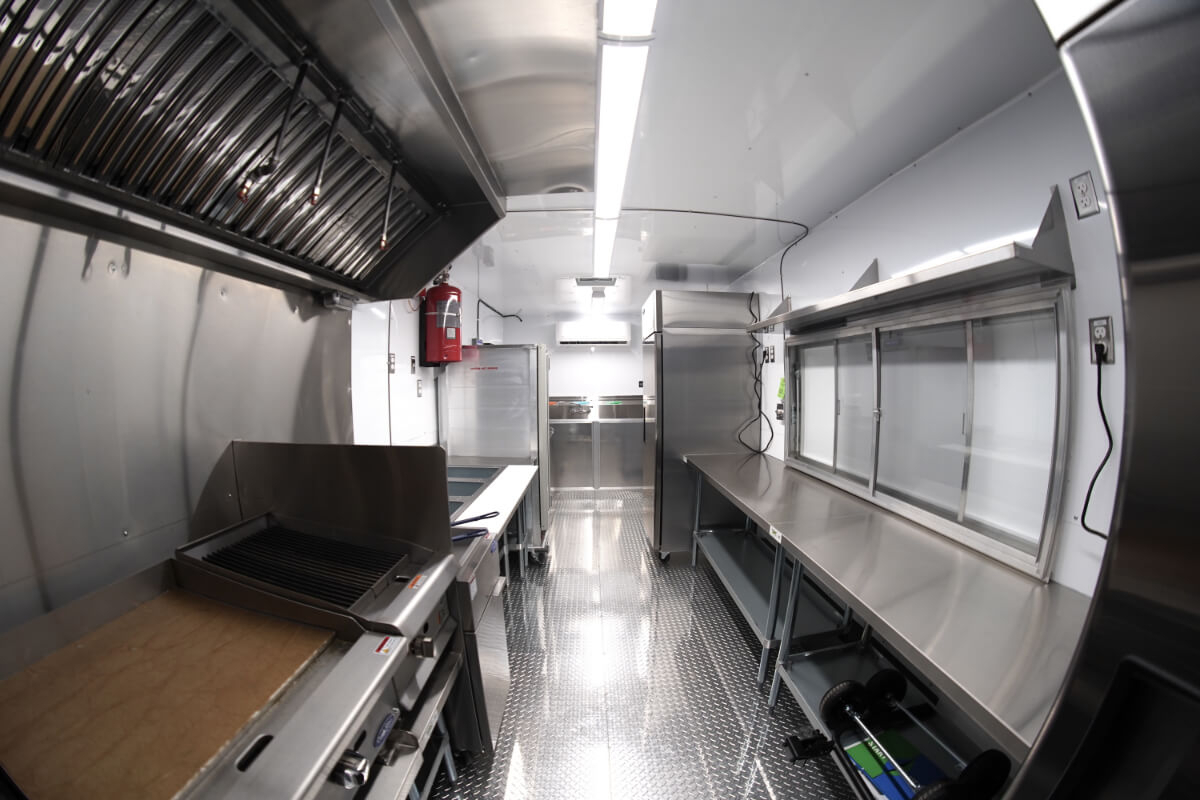
Most food truck layout problems don’t surface at the design stage. They show up six months into operation.A second crew member gets added for a busy weekend and there’s nowhere for them to stand without interrupting the cook. A health inspector flags a sink that ended up in the wrong position. A line cook realizes they’ve been rotating 180 degrees to plate every order because the holding surface landed on the wrong side of the station.
We’ve built custom food trucks and trailers for over 20 years, and the pattern is consistent: operators who end up with kitchens that work spent time mapping workflow before they spent time selecting equipment. The ones who skipped that step are usually the ones calling about modifications six months after delivery.
What follows covers every decision that separates those two outcomes – from workflow sequencing and equipment selection to compliance, ergonomics, and the service window.
Key Takeaways
- Map how food moves from storage to window before placing any equipment – that sequence determines everything downstream.
- Select appliances for your specific menu, not for what fills the available footprint.
- Vertical storage through wall shelving, hanging racks, and under-counter units recovers floor space most operators leave unused.
- Sink placement and hood clearances are structural decisions – operators who treat them as finishing details pay to correct them after the build.
- Crew ergonomics affect ticket times. Work surface heights, flooring, and ventilation are operational decisions, not comfort upgrades.
- The service window controls line speed and customer perception simultaneously – placement, depth, and menu visibility all require deliberate design choices.
Start with Workflow, Not Equipment
The instinct when planning a food truck kitchen is to start with an equipment list – everything needed to cook the menu – and then figure out how to fit it inside the available space. That approach produces kitchens where the equipment is present but the workflow is broken.
Start instead with one question: how does food move through this truck?
Trace the path of one menu item from the moment ingredients are pulled to the moment the finished plate reaches the window. That path should travel in one continuous direction – storage to prep to cook to plate to pass – with each zone feeding directly into the next.
A functional layout runs through these zones in order:
- Storage – refrigeration and dry goods positioned at the workflow’s start, so ingredients move forward through the kitchen rather than backward
- Prep station – dedicated counter space for portioning, cold assembly, and staging
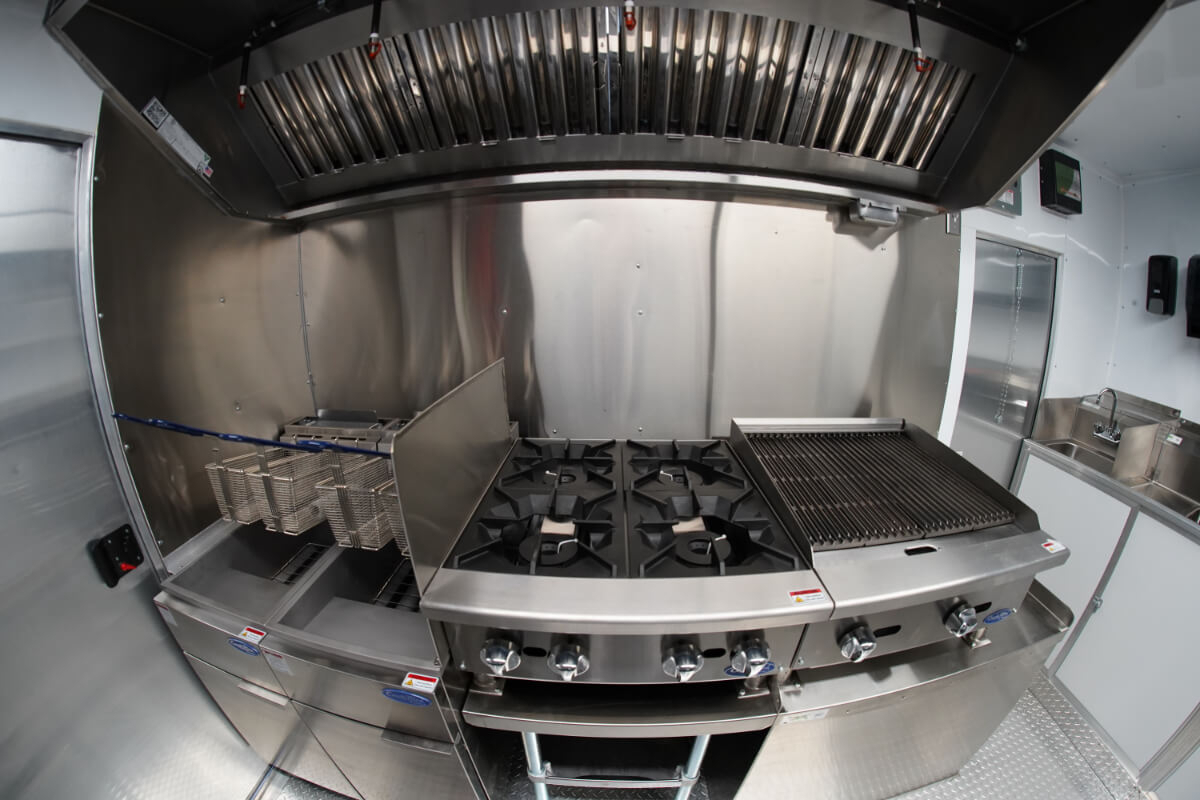
- Cook station – the specific combination of grill, fryer, range, or steamer the menu requires
- Holding and plating – a brief staging surface between the cook station and the window where finished items wait for handoff
- Service window – sized and positioned for the actual pace of service
- Cleaning station – three-compartment sink and handwashing sink, positioned outside the active cooking flow so sanitation activity doesn’t cut across the line
Sink placement deserves specific attention. Health codes require both a three-compartment sink and a separate handwashing sink, and those two fixtures consume significant linear wall space.
When that placement gets resolved at the end of a design conversation rather than the beginning, it frequently ends up cutting directly across the workflow it should be sitting outside of – forcing crew members to navigate around sanitation activity during active service.
The layout also needs to work for two people moving simultaneously at peak conditions.
A configuration that runs cleanly for one operator at noon can generate constant interference during a dinner rush once a second crew member is added. The relevant test is whether two people can execute their full range of tasks at the same time without disrupting each other – which is a different question than whether two bodies fit inside the truck.
Equipment Selection Follows Menu, Not Floor Plan
Once the workflow sequence is established, equipment selection follows directly: choosing the specific tools that serve each zone, sized and configured for what’s actually being cooked.
A smash burger operation needs a flat-top griddle with enough surface area to run multiple patties simultaneously, a high-output exhaust hood directly overhead, and refrigeration close enough to the cook surface that restocking doesn’t pull someone away from their station.
A truck serving steamed dumplings or bao needs a bank of commercial steamers – with different ventilation requirements and counter height considerations entirely.
A dessert-focused concept may need three times the freezer capacity before it needs a single burner.
These aren’t interchangeable configurations, and a floor plan built for one concept will produce real operational compromises when forced onto another.
Before finalizing equipment, work through these questions against the specific menu:
- Which items need to cook simultaneously during a peak rush, and do the appliances producing them fit on adjacent surfaces with safe operating clearances?
- Which equipment generates the most radiant heat, and how does its placement affect where the ventilation hood needs to land?
- Where can combination units – refrigerated prep tables, convection-microwave ovens, proofer/warmer cabinets – consolidate two functions into one footprint and recover space for movement?
Compact commercial equipment is worth taking seriously. Countertop fryers, undercounter refrigeration, and space-saving steam units deliver equivalent output in a fraction of the footprint of full-size counterparts.
Our food truck equipment guide covers the specific units that hold up under daily commercial use and the configurations worth considering for different menu types.
Vertical Space Is the Resource Most Operators Leave Unused
A crew working a poorly organized food truck kitchen rarely complains about the size of the truck. They complain about the countertops – specifically, that there’s never enough clear surface during service.
In most cases the problem isn’t the counter area. It’s that everything that could be stored off the counter isn’t.
Wall-mounted shelving, magnetic knife strips, hanging wire baskets, pegboard tool organization, and overhead storage rails all move storage off working surfaces without adding to the footprint.
Under-counter refrigeration handles bulk ingredient storage below the prep surface. Reach-in units against the back wall keep frequently pulled items accessible without requiring anyone to leave their station.
A few specifics that need to be resolved during the design stage:
- Shelving height relative to task frequency. Items pulled repeatedly during service should sit between waist and shoulder height. Storage above shoulder height forces crew members to stop, reach, and reset – repeated across a full service, that lost motion adds up and contributes to fatigue by the back half of a shift.
- Weight placement in trailer builds. Heavy storage – bulk dry goods, full water tanks, dense equipment – should sit low and centered along the trailer’s longitudinal axis. Weight concentrated toward the walls or at one end affects how the trailer tracks on the road and stresses the frame over time.
- Anchoring to structure, not panel. Wall-mounted equipment needs to be fastened to structural framing members. Road vibration is constant in a trailer build, and anything anchored to panel material alone will work loose over time – sometimes gradually enough that the problem isn’t visible until a mount has already failed.
Compliance Is a Design Constraint, Not a Finishing Step
Operators who end up retrofitting compliance items into a finished build made the same mistake: they treated health and safety requirements as a checklist to satisfy after the kitchen was designed, rather than as constraints that shape the layout from the start.
The costs are specific. Retrofitting a three-compartment sink into a layout that didn’t account for it means relocating equipment, replumbing, and losing counter space the workflow depended on.
An exhaust hood that doesn’t meet the jurisdiction’s clearance requirements after installation has to come out.
An improperly positioned fire suppression nozzle requires repositioning the cooking equipment underneath it – which can mean rebuilding the cook station entirely.
The core requirements most jurisdictions mandate for mobile food service:
- Three-compartment sink with enough linear space for actual wash-rinse-sanitize workflow, not just nominal installation
- Separate handwashing sink, accessible from the cooking area without crossing the active cook station
- Grease-rated mechanical exhaust hood over all cooking equipment, with required clearances above the cooking surface
- Fire suppression system integrated into the hood, with nozzle placement that meets code for the specific equipment positioned underneath it
- Minimum clearances around all cooking equipment for both operation and maintenance access
Texas and California each publish specific construction standards for mobile food units through their health departments. Operating across state lines means the most restrictive applicable standard becomes the baseline – not an average of the two.
The fire suppression requirement carries downstream layout consequences that operators consistently underestimate. Suppression nozzle placement dictates where cooking equipment can sit relative to the overhead hood, and that positioning affects the entire cook station configuration.
Working this out on paper before fabrication begins costs nothing. Discovering it at inspection costs significantly more. Our custom builds are engineered to meet local health codes before they leave the shop.
The Kitchen Environment Directly Affects Service Output
A food truck kitchen that’s physically difficult to work in will underperform regardless of how well it’s equipped. The physical environment affects stamina, concentration, and speed – and those effects compound over the course of a long service.
Lighting
Task lighting directly over prep and cook surfaces matters more than ambient overhead fixtures.
A cook working over a cutting board or a hot line in poor light works slower and makes more errors. Overhead-only lighting casts shadows over the areas that require the most precision.
Flooring
Commercial anti-fatigue mats over slip-resistant surfaces. A bare steel floor is both a compliance hazard and a physical punishment.
The difference in crew fatigue between a properly cushioned surface and a hard floor becomes visible in service quality during the back half of a long shift – slower plating, more errors, shorter patience.
Ventilation and Temperature Control
Cooking equipment in an enclosed space generates significant heat. A properly specified exhaust system removes grease-laden air and draws fresh air through the truck.
Without supplemental cooling – a rooftop HVAC unit or a well-positioned evaporative system – interior temperatures during a summer service can reach the point where crew performance degrades well before the shift ends.
Our post on keeping your food truck cool through a full service covers equipment options and positioning in detail.
Work Surface Consistency
Appliances and work surfaces set at consistent heights across the cook line let crew members move between stations without adjusting posture.
An inconsistent line – where one surface sits two inches lower than the next – forces repeated postural adjustments that accumulate into real physical strain over a six-hour service.
Getting surface heights right during the build costs nothing. Correcting chronic crew fatigue and the turnover it produces costs considerably more.
The Service Window Has Two Jobs Simultaneously
The service window is where the kitchen’s entire output gets handed off, and it’s the first thing every customer sees up close. Most layout conversations don’t give it enough attention on either front.
Pass-Through Depth Affects Handoff Speed
A narrow shelf creates fumbling when multiple items are ready simultaneously. Enough counter depth to stage two or three items at once prevents the bottleneck that forms when a second order is plated before the first has been collected.
Menu Visibility Affects Line Speed Directly
Customers read the board while waiting. If it’s undersized, positioned too high, poorly lit after dark, or organized in a way that buries high-frequency items, customers arrive at the window undecided.
An undecided customer stops the line for everyone behind them. At minimum, the most-ordered items should be readable from ten feet away, in daylight and at night.
Exterior Presentation Sets Expectations Before Any Transaction Happens
A retractable awning over the service window shades waiting customers, creates a visual anchor, and signals a level of professionalism that a bare window doesn’t.
Vehicle wraps, custom signage, and consistent exterior branding turn the truck into a marketing surface.

Construction Quality Determines How Long the Layout Holds Up
The failure mode in food truck construction isn’t usually dramatic – it’s gradual.
Seams that weren’t fully sealed start collecting grease after the first few months of service. Equipment mounts anchored to panel rather than framing begin working loose after enough road miles. Refrigeration fighting inadequate insulation runs harder, cycles more frequently, and fails sooner than it should.
Specific things worth confirming before signing a fabrication contract:
- Interior surfaces: stainless steel is the commercial standard because it resists corrosion, cleans quickly, and doesn’t trap bacteria the way porous materials do. It’s the functional baseline for a kitchen that gets sanitized daily under health department scrutiny – not a finish upgrade.
- Seam sealing: every joint between wall panels, floor transitions, and equipment mounting points needs to be fully sealed. Gaps that look minor during a build walkthrough become grease traps and moisture entry points within a season of daily use.
- Insulation specification: the difference between a minimally insulated build and a properly insulated one shows up in utility costs, refrigeration lifespan, and interior working temperature across a full operating season.
Any fabricator worth working with answers construction questions with specific materials and specs. If the answer to a direct question about insulation R-value or seam sealing method is a general reassurance about quality, that’s a clear signal to keep asking – or to look elsewhere.
Conclusion
The decisions that determine whether a food truck kitchen works under pressure are almost all made before fabrication begins.
Workflow sequence, equipment configuration, compliance integration, crew ergonomics, and service window design aren’t details to sort out mid-build – they’re the build. Operators who work through these questions at the design stage open on time, pass their first inspection, and run cleaner services from day one.
If you’re at the planning stage, request a quote and we’ll start with the workflow conversation before anything else.