

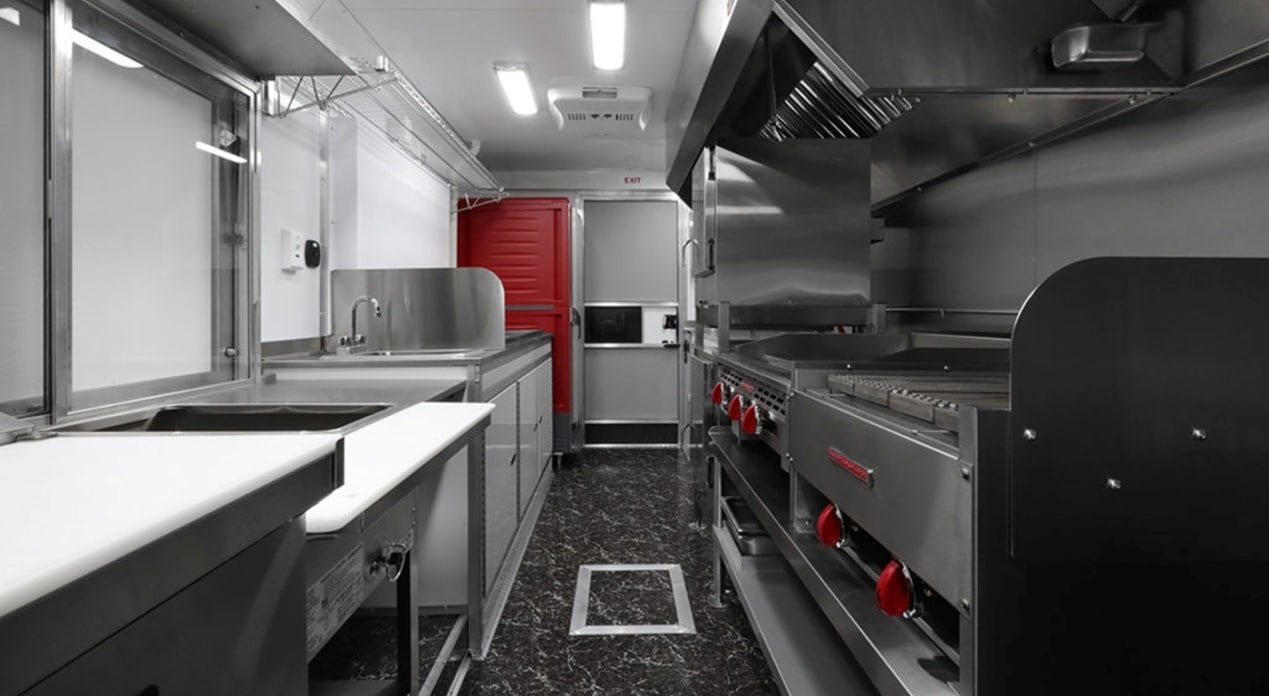
The equipment inside your food truck determines what’s actually possible once the window opens. Before you develop your menu or scout locations, you need a kitchen that can handle the physical demands of mobile food service: volume, heat, compliance, and the kind of repetitive stress that exposes every weak link in a setup.
This list covers the 10 pieces of equipment that make the biggest practical difference. Not just for passing your initial inspection, but for building a mobile kitchen that performs under pressure, day after day, in whatever market you’re operating.
Key Takeaways
- Health codes in most jurisdictions require all food truck equipment to be commercial grade; residential appliances are not permitted.
- Any truck running grease-producing equipment needs a Type I exhaust hood with a built-in fire suppression system.
- Your water system must include both a potable water tank and a wastewater tank. Most regulations require the wastewater tank to be larger than your clean supply.
- Generator sizing depends on your total electrical load; getting it wrong creates operational problems no workaround can fully solve.
- Storage and prep station layout directly affect how fast your crew can work during peak service hours.
1. Commercial-Grade Grill or Griddle
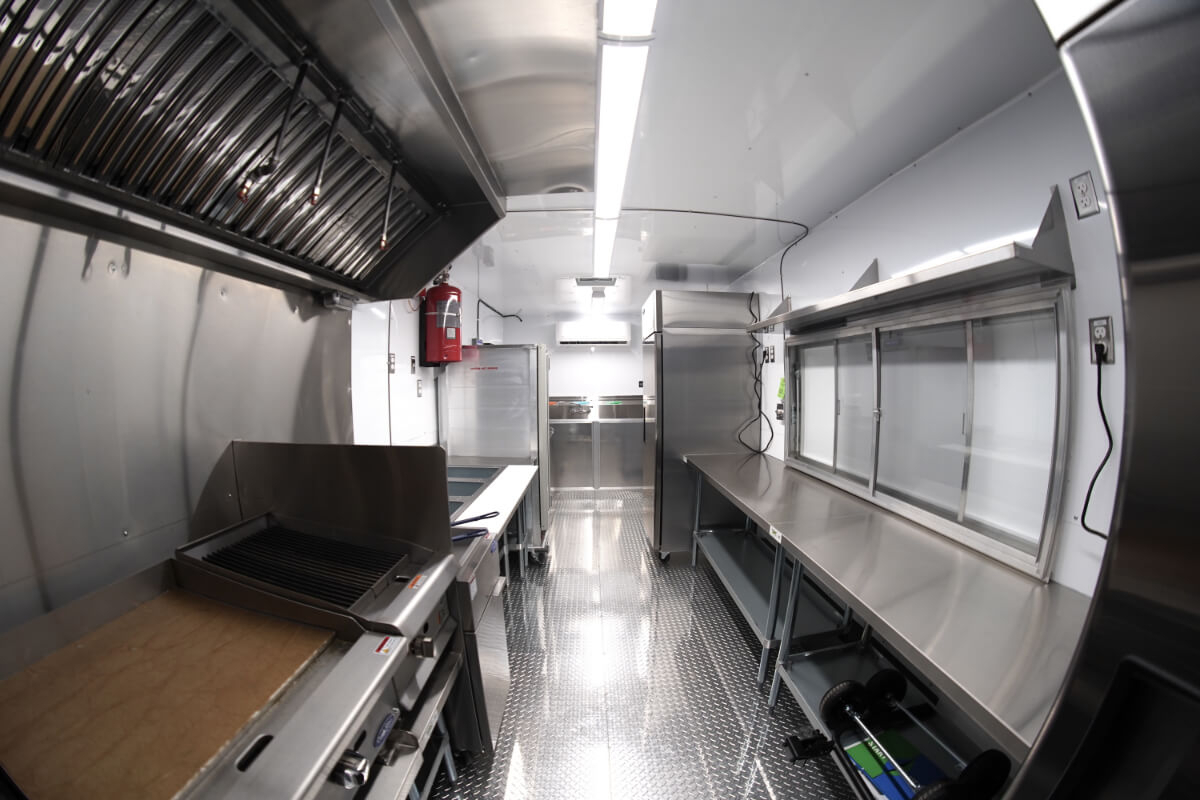
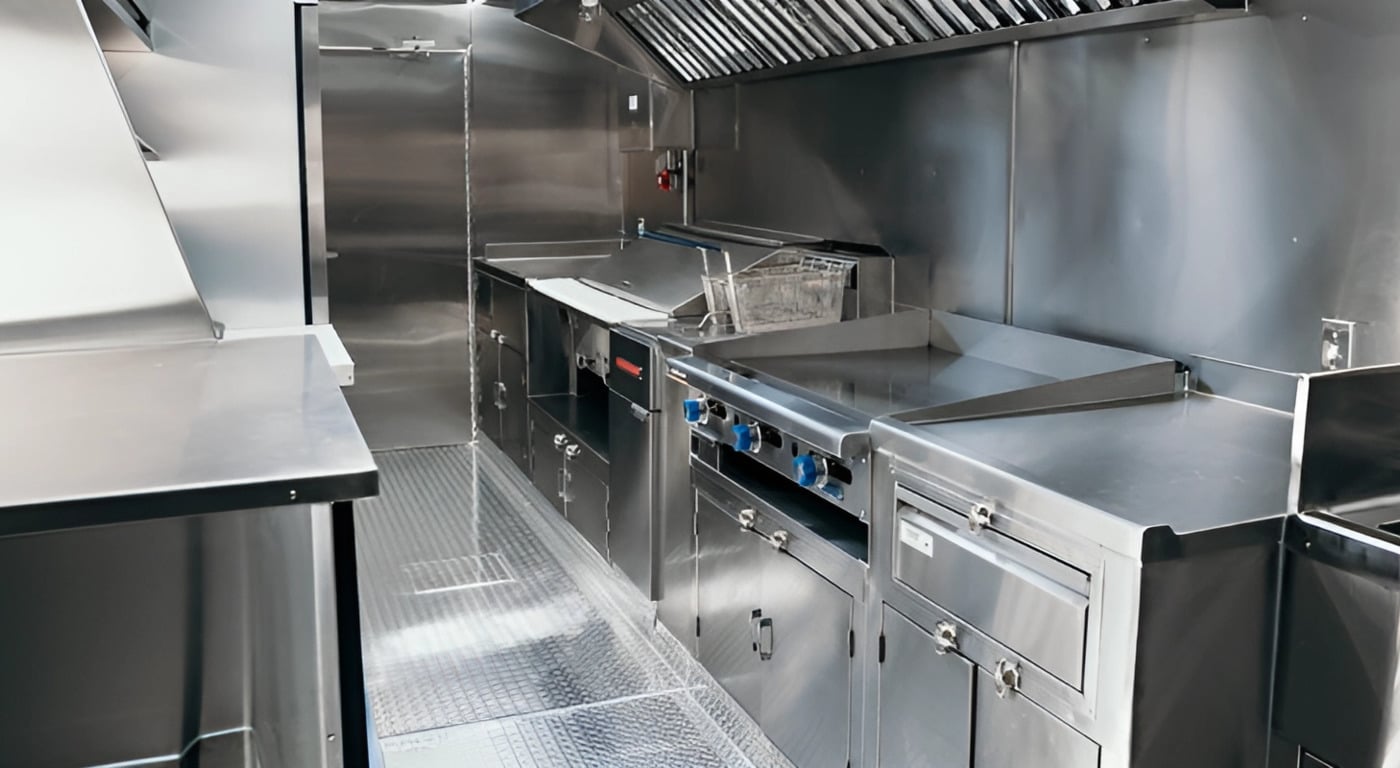
A flat-top griddle is the workhorse of most food truck kitchens.
It handles burgers, breakfast plates, proteins, and smash-style sandwiches with equal efficiency, and consistent heat distribution across the surface is what keeps output steady when you’re cooking at volume.
The spec that matters most is BTU output relative to cooking surface area. An underpowered griddle recovers slowly between cooks, and that lag compounds quickly during a lunch rush. No amount of prep work offsets a bottleneck at the cooking surface.
Whatever cooking equipment you choose, it needs to meet commercial-grade standards. Health departments across the country don’t permit residential-rated appliances in a licensed mobile kitchen, regardless of how capable they appear on paper.
2. Deep Fryer
A commercial fryer is essential for any menu that includes fried items: french fries, onion rings, fried chicken, churros, or anything else that requires full oil immersion.
High-capacity commercial fryers maintain oil temperature more consistently than residential or light-duty models, which means food cooks at the right speed and doesn’t absorb excess oil during the process.
Placement is juast as important. The fryer needs to sit directly under your Type I exhaust hood, and your layout needs to account for grease trap and drainage requirements that inspectors will check.
The cooking equipment decisions and the ventilation decisions are connected; plan them together.
3. Refrigeration and Cold Storage
Proper cold storage is both a food safety requirement and a practical operational need.
Health codes mandate that time- and temperature-controlled foods stay within safe ranges throughout service, which means your refrigeration has to keep up with ambient heat, frequent door openings, and the thermal load of a busy kitchen running nearby.
Most operators use a combination of under-counter refrigerators for ingredients accessed during service and a reach-in or chest freezer for backup stock. The right configuration depends on your menu, your commissary schedule, and how much volume you’re doing.
Having slightly more cold storage capacity than you think you need is rarely a mistake. Running short during a busy shift is a much harder problem to solve.
4. Three-Compartment Sink and Handwashing Station
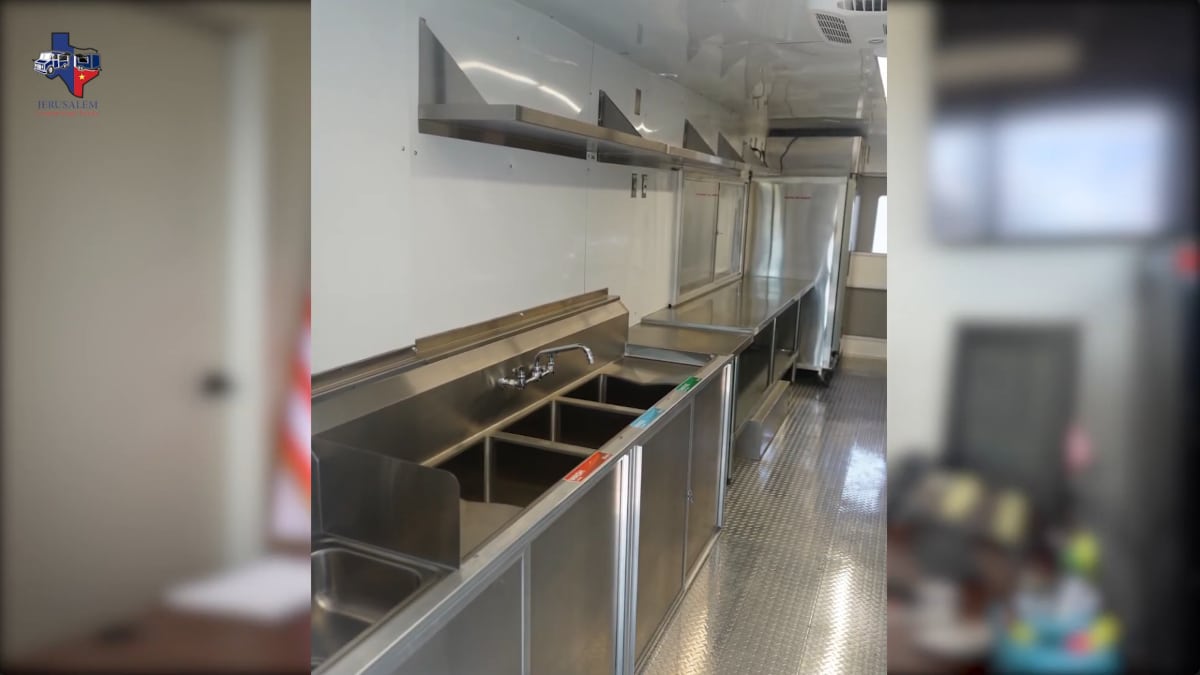
Most health codes require mobile food units to have at minimum a three-compartment sink, with one basin each for washing, rinsing, and sanitizing, plus a dedicated handwashing sink that can’t share a basin with anything else.
Requirements vary by jurisdiction, but this configuration is the standard baseline nearly everywhere.
These sinks connect directly to your water system. Your potable water tank supplies clean water to both stations, while your wastewater tank collects gray water. Most regulations require the wastewater tank to be larger than the clean supply tank, typically by around 15%.
Getting tank sizing right at the build stage is important; retrofitting later is expensive and often structurally complicated. Our post on designing your custom food truck covers how these systems get integrated during the layout phase.
5. Exhaust Hood and Fire Suppression System
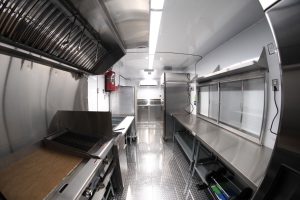
If your truck runs a griddle, fryer, or any other grease-producing equipment, a Type I commercial exhaust hood is required.
Type I hoods include integrated grease filters and must be paired with a fire suppression system. The UL-300 standard is the reference point most jurisdictions use, and your fire marshal inspection will check for it.
Hood sizing has to match the equipment underneath it. An undersized hood can’t handle the grease-laden air a busy griddle produces, which leads to buildup, inspection violations, and real fire risk.
Beyond compliance, adequate ventilation makes a meaningful difference in working conditions. A properly functioning hood system keeps heat and smoke moving out of the space your crew is working in. We cover this in more detail in our guide on how to stay cool in your food truck.
6. Water Filtration System
Water quality affects both the food you produce and the equipment you’re running it through.
Hard water is common across large parts of the country, and it causes mineral buildup in steam equipment, coffee machines, and ice makers over time. A filtration system installed at the point where water enters your truck prevents that buildup from accumulating in the first place.
For operators running coffee, tea, or dishes where water is a visible ingredient, filtration also produces a noticeable improvement in flavor. It’s not glamorous equipment, but the cost of a good inline filter is modest compared to the cost of replacing a descaled espresso machine or a failed ice maker.
7. Generator
Your generator powers everything else on this list.
Sizing it correctly means adding up the wattage requirements of every piece of electrical equipment on the truck: refrigeration compressors, fryers, lighting, POS terminals, and ventilation fans, then selecting a unit with enough headroom to handle simultaneous peak loads.
Running a generator that’s too small forces you to prioritize between equipment or causes power inconsistencies. One that’s significantly oversized burns more fuel than necessary for every hour you operate. The right size is specific to your build and your menu.
Fuel efficiency matters too; a generator that runs eight to ten hours a day has a measurable impact on operating costs over the course of a season.
Generator sizing is one of the questions worth raising with your builder before the build begins. Our post on what to ask a food truck manufacturer before you sign anything walks through the right conversations to have before you commit.
8. Food Preparation Stations
Counter space is one of the most underestimated factors in food truck kitchen design.
When orders come in quickly, your crew needs dedicated surfaces for chopping, portioning, assembling, and plating. If those tasks compete for the same 18 inches of counter, service slows down in ways that are hard to diagnose from the outside.
Effective prep station design means thinking through your specific menu and mapping out each step of the process.
- Where does raw protein get handled?
- Where does plating happen?
- Where do sauces live during service?
Answering those questions before the build determines whether your layout supports smooth service or creates friction that compounds under pressure.
Stainless steel work surfaces are the standard for commercial kitchens. They’re durable, non-porous, and easy to sanitize, which matters both for health compliance and for daily cleanup at the end of service.
9. Storage for Utensils and Supplies
In a space measured in square feet rather than square yards, how you store things is as important as what you store.
Utensils, smallwares, dry goods, condiments, and packaging all need a designated place, and that place needs to be accessible during service without requiring someone to stop and dig.
Cabinets, drawers, and shelving designed around your specific inventory make a real operational difference.
When everything has a fixed location, service runs more cleanly, waste goes down, and end-of-shift restocking becomes faster. That kind of efficiency doesn’t show up in a single transaction, but it adds up across a full season of service.
10. Serving Window and Exterior Display
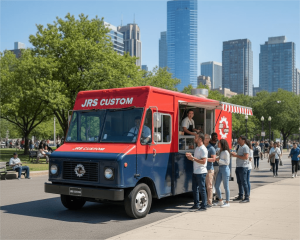
The serving window is where your operation meets your customer, and its design affects both the transaction itself and how customers perceive your truck from the street.
A well-positioned window at an ergonomic height makes order-taking and handoffs easier for staff. Good visibility around the window, through a menu board, digital display, or branded signage, helps customers decide before they reach the front of the line.
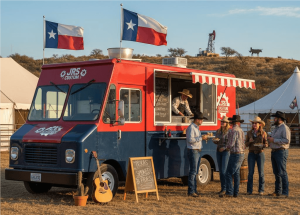
Exterior appearance carries practical weight too. A well-branded truck communicates professionalism and draws attention in a crowded event or food truck park, where the physical look of the vehicle is often the first thing a potential customer notices.
Wraps, signage, and display elements are part of the build conversation rather than an afterthought, and getting them right the first time is more cost-effective than retrofitting later.
Conclusion
The right equipment doesn’t just help you pass inspection; it determines how well your kitchen functions under the conditions you’ll actually face.
Decisions made during the build phase set the ceiling for what’s operationally possible once you’re open.
If you’re planning a new build or reconsidering the layout of an existing truck, our team at JRS Custom Food Trucks & Trailers works through these decisions with every client, from equipment selection to layout to compliance requirements specific to your market.